



Anti Vibration Mounts for Air Compressors
Air Compressor Vibration Explained: A Practical Guide to Anti Vibration Mounts
Air compressors naturally generate vibration. Every piston stroke, pump cycle, and pressure pulse inside the tank produces mechanical energy that travels through the unit and into the floor. Smaller compressors create noticeable but manageable vibration, while 60–80 gallon machines produce much stronger forces. That’s when owners start feeling the hum through concrete, hearing amplified noise, or noticing the compressor slowly “walking” across the shop.
As compressors wear, vibration often increases. Looser clearances, aging components, and harmonic resonance all contribute to louder operation and more movement. When a compressor sits directly on concrete or wood blocking, that vibration transfers into the slab, echoing through the workspace and stressing fittings, mounts, and even the tank itself. Proper isolation keeps the compressor stable, limits structural transmission, and reduces overall noise.
 Vibration Isolators 1" x 3/4" | Natural Rubber
$2.59
Vibration Isolators 1" x 3/4" | Natural Rubber
$2.59
 Rubber Vibration Mount 1" x 1/2" | Natural Rubber
$2.79
Rubber Vibration Mount 1" x 1/2" | Natural Rubber
$2.79
 Vibration Isolators 3 1/8" x 3" | Natural Rubber
$29.99
Vibration Isolators 3 1/8" x 3" | Natural Rubber
$29.99
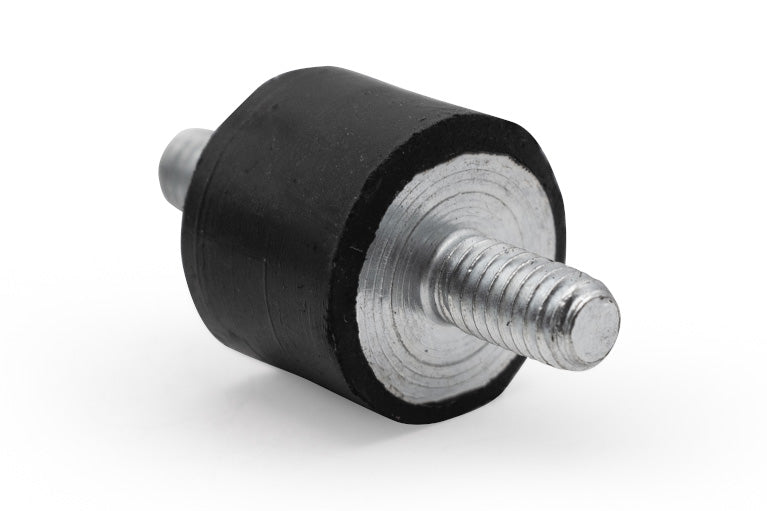 Vibration Isolators 2" x 3/4" | Natural Rubber
$4.79
Vibration Isolators 2" x 3/4" | Natural Rubber
$4.79
 Rubber Vibration Isolator Mounts 9/16" x 1/2" | Natural Rubber
$2.79
Vibration Isolation Mount - 2 Studed
$2.59
Rubber Vibration Isolator Mounts 9/16" x 1/2" | Natural Rubber
$2.79
Vibration Isolation Mount - 2 Studed
$2.59
 Vibration Isolators 1" x 1" | Natural Rubber
$3.79
Vibration Isolators 1" x 1" | Natural Rubber
$3.79
 Vibration Isolator 1" x 3/8" | Neoprene
$3.29
Vibration Isolator 1" x 3/8" | Neoprene
$3.29
 Vibration Isolation Feet 1.29" x 1 3/8" | Natural Rubber
$3.79
Vibration Isolation Feet 1.29" x 1 3/8" | Natural Rubber
$3.79
 Isolation Rubber Mounts
$3.79
Isolation Rubber Mounts
$3.79
 Vibration Isolators 3" x 2 1/4" | Natural Rubber
$19.99
Vibration Isolators 3" x 2 1/4" | Natural Rubber
$19.99
 Vibration Isolators 1 1/2" x 1" | Natural Rubber
$3.79
Vibration Isolators 1 1/2" x 1" | Natural Rubber
$3.79
How Anti Vibration Mounts for Air Compressors Work
Anti vibration mounts interrupt the direct contact between a compressor and the floor, absorbing energy instead of transferring it through the tank and legs. As the rubber compresses, it dissipates vibration as low-level heat, significantly reducing what reaches the ground. This lowers noise, prevents movement, and lessens strain on the tank during every run cycle.
An effective mount also lowers the system’s natural frequency so vibrations aren’t amplified at operating RPMs. The result is stable, quieter performance without modifying the compressor itself.
High-quality mounts help control:
- Movement and walking
- High-frequency vibration from reciprocating pumps
- Noise caused by metal-to-concrete contact
- Long-term stress that can lead to leaks or wear
DIY Fixes Users Try (and Their Limitations)
Forum users offer plenty of creative tactics for stopping compressor vibration, but most aren’t designed for the weight or frequency range of an air compressor. They may reduce sliding, but rarely provide true vibration isolation.

Why common DIY options fall short:
- Hockey pucks: Too rigid to absorb vibration.
- Cork pads: Compress or crumble under heavy static loads.
- Stall mats / bedliner scraps: Add grip but provide minimal damping.
- Rubber belting: Inconsistent density, unpredictable performance.
- Wood blocks or shims: Good for leveling, not vibration control.
These materials may stop movement temporarily, but they don’t deliver the long-term isolation required to protect the compressor and reduce noise.
What Makes a Quality Vibration Mount
Air compressors generate both low- and high-frequency vibration, requiring mounts with the right mix of elasticity, hardness, and long-term durability. A mount should compress enough to absorb energy without collapsing, hardening, or degrading over time.
Key factors to look for:
- Durometer: Medium firmness to balance support and vibration damping.
- Compression set resistance: Holds its shape under continuous load.
- Environmental durability: Withstands oils, humidity, ozone, and temperature changes.
Common rubber compounds used for compressor mounts:
| Material | Strengths | Best Use |
|---|---|---|
| Natural Rubber | Excellent isolation, strong elasticity | Indoor compressor setups |
| Neoprene | Oil- and chemical-resistant, stable under load | Shops with oil exposure |
| EPDM | Weather- and ozone-resistant | Outdoor or exposed environments |
Should You Bolt Your Compressor Down?
Rigidly anchoring a compressor directly to concrete can increase vibration stress and, over time, contribute to fatigue in tanks or fittings. Without isolation material, every vibration travels into the tank shell and mounting feet.
The goal is stability, not rigidity. Bolting is acceptable when paired with vibration mounts that allow limited, controlled movement.
Best practices:
- Place a mount under each foot and anchor through the mount.
- Tighten bolts only until they make contact—then loosen slightly.
- Ensure each mount compresses evenly to avoid twisting the tank.
Choosing the Right Mount for Your Setup
Correct mount selection ensures the compressor stays stable, quiet, and protected from vibration-related wear. Match mount capacity and material with compressor size and shop environment.
Quick selection checklist:
- Load rating: Each mount should support at least 25–30% of total compressor weight.
- Material choice: Natural rubber for indoor use, neoprene for oily environments, EPDM for outdoor conditions.
- Durometer: Medium hardness provides effective isolation without excessive deflection.
- Floor type: Smooth or epoxy floors may require mounts with better grip.
- Need for anchoring: Bolt-through mounts offer stability without eliminating isolation.
Installation Tips for Better Isolation
Proper installation ensures mounts work as designed. Uneven compression, overtightened anchors, or misalignment can reduce isolation and increase stress on the tank.
Installation guidelines:
- Level the compressor before tightening bolts.
- Ensure each foot sits squarely on the mount.
- Avoid overtightening anchors; snug is enough.
- Keep surfaces clean of dust and oil to maximize grip.
- Recheck mount compression after initial run cycles.
With correct installation, mounts can significantly reduce noise, eliminate walking, and minimize vibration transfer into the floor.
Effective isolation isn’t a luxury—it’s a major improvement in performance, comfort, and long-term compressor health.


Your Best Source for Reliable Compressor Mounts
For over 50 years, Enterprise Rubber has engineered durable, high-performance vibration-control components used across industrial applications. Our anti vibration mounts for air compressors are manufactured in the U.S. using high-quality compounds and consistent durometer control to ensure long-lasting stability. Whether you need standard mounts or custom-molded solutions, our team can recommend the right setup for your environment and equipment.
Ready for a quieter, more stable compressor?
Contact Enterprise Rubber today for proven vibration-control solutions built to last.
Troubleshooting a Compressor That Walks or Vibrates Excessively
Cover leveling, loose hardware, worn components, improper anchoring, piping strain, unbalanced loads and incorrectly selected mounts.
Do I need vibration pads under an air compressor?
Vibration pads or isolator mounts may help when a compressor transfers noticeable vibration and noise into the floor. The correct solution depends on the compressor's weight, mounting design, operating forces and floor structure.
What type of vibration isolator is best for an air compressor?
The appropriate isolator depends on the load at each mounting point, available space, attachment method, vibration frequency and surrounding environment. Studded rubber mounts are often used when a secure mechanical connection is required.
Can I put a rubber mat under an air compressor?
A rubber mat may reduce minor vibration transmission, but it does not provide the controlled load and deflection of properly selected isolator mounts. It should not interfere with required anchoring, ventilation or drainage.
How do I stop a vertical air compressor from walking?
First check leveling, mounting hardware, mechanical condition and piping strain. Properly selected isolators may reduce transmitted vibration, but they should not be used to conceal an equipment or installation problem.
Can vibration isolators be used on a wood floor?
They can reduce vibration transmission, but a wood floor may amplify low-frequency movement. The floor must be evaluated for structural capacity, stiffness and safe compressor installation.
How many vibration mounts does an air compressor need?
Use the number of mounting locations specified by the compressor manufacturer. Calculate the load at each location rather than assuming the compressor's weight is distributed evenly.