



Rubber Mounts for Exhaust Systems: Industrial Isolation & Vibration Control Guide
Continuous physical vibration and rapid thermal cycles pose severe structural risks to industrial exhaust manifolds, piping, and mounting brackets. Without dynamic isolation, operational forces transfer directly from the engine block through connected pipework, causing weld shear, structural cracking, and early hardware failure.
Properly integrating high-performance rubber mounts for exhaust systems resolves this issue by decoupling kinetic forces before they cause system-wide damage. For equipment designers, plant engineers, and procurement managers, specifying engineered elastomeric isolators is the most effective approach to reducing equipment exhaust fatigue and avoiding costly unplanned downtime.
Rubber Mounts for Exhaust Systems: Mechanics of Harmonic Vibration and Exhaust Fatigue
Every mechanical assembly operates with distinct resonant frequencies. When operational vibrations generated by engines align with the natural frequency of an attached exhaust system, resonance occurs. This condition amplifies mechanical motion beyond intended design parameters, leading to rapid material degradation.
Vibration-Induced Degradation Modes
Engines produce complex wave patterns containing both low-frequency shake and high-frequency structural chatter:
- Flex Joint Tears: Continuous motion forces flexible metal bellows past cycle limits, creating leak pathways.
- Flange Micro-Fracturing: Rigid mounting transfers torsional twisting directly to bolted flanges, fracturing stud holes.
- Fastener Back-Out: High-frequency chatter overrides thread friction, loosening critical manifold bolts and hangers.
- Thermal Growth Stress: Rapid linear heat expansion combined with engine movement generates severe bending and shear stress at rigid anchor points.
Thermal Expansion and Dynamic Stress
Exhaust piping expands and contracts rapidly across wide operating temperature spans. While heat causes physical linear growth along the pipe, engine movement forces the pipe into bending and shear modes. High-performance isolators accommodate this multi-axial movement, allowing thermal growth without generating high stresses at rigid structural anchor points.
Choosing Elastomers for High-Heat Environments
Selecting the ideal elastomer formulation is critical when specifying vibration isolation mounts exposed to high operating temperatures and harsh engine bay chemicals.
Rubber Mounts for Small Engines and High-Temperature Applications
- Natural Rubber (NR): High tensile strength and premium vibration damping for ambient environments away from direct manifold heat radiation.
- EPDM (Ethylene Propylene Diene Monomer): Superior resistance to thermal degradation, ozone exposure, and UV weathering near high-temperature zones.
- Neoprene (Polychloroprene): Balanced defense against petroleum-based fluids, fuel vapors, and moderate heat in commercial engine compartments.
- Nitrile (NBR): Maximum protection against direct oil drips, hydraulic fluids, and grease contamination to prevent material swelling.
Key Criteria for Engine Vibration Isolators
Specifying engine vibration isolators requires evaluating mechanical load orientations, environmental exposure limits, and operational stress patterns.
| Specification Parameter | Technical Consideration | Operational Impact |
|---|---|---|
| Load Vector | Compression vs. shear force orientation | Prevents over-deflection under heavy shock loads |
| Durometer Rating | Shore A hardness scale (40 to 70 Shore) | Defines stiffness, load capacity, and natural frequency |
| Chemical Exposure | Proximity to fuel, oil, and outdoor weather | Dictates elastomer choice to prevent degradation |
Mounting Configurations and Installation Profiles
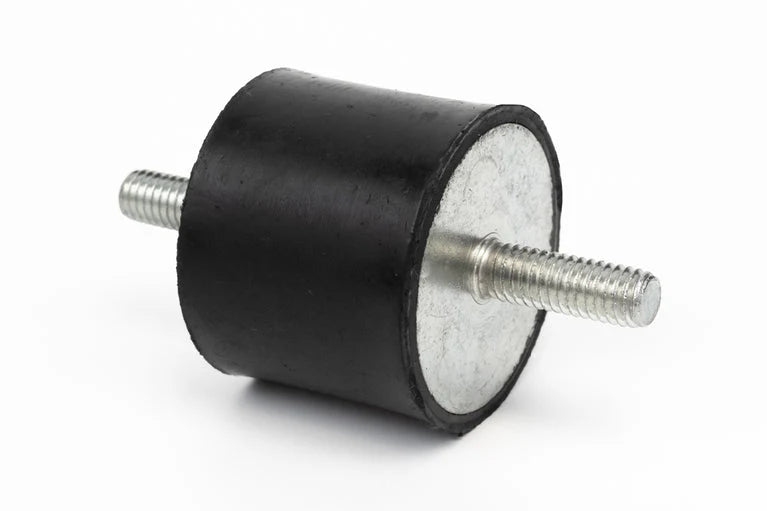
- Male-Male Stud Mounts: Quick installation through standard mounting plates and chassis brackets.
- Male-Female & Female-Female Mounts: Compact profiles ideal where clearance is limited and offset fastening is required.
- Tapered Cylindrical Mounts: Progressive stiffness under lateral loads for high stability under sudden side-load shifts.
Integration Benefits for OEM Equipment and Field Machinery
Integrating targeted rubber mounts for small engines and exhaust line components provides several immediate field benefits:
- Structural Life & Reduced Warranty Costs: Eliminates stress propagation through framing, protecting manifolds, studs, and sheet metal across severe duty cycles.
- NVH Reduction & Operator Comfort: Isolates mechanical vibration before it radiates through equipment housing, lowering overall decibel output.
Protect Your Equipment with Enterprise Rubber Technical Solutions
Preventing equipment exhaust fatigue begins with engineered vibration control at the mounting surface. For over five decades, Enterprise Rubber has manufactured precision rubber-to-metal bonded mounts, custom-molded elastomeric components, and industrial isolators engineered to withstand demanding operating environments.
Our technical team works alongside OEMs, plant managers, and equipment designers to formulate elastomeric compounds and supply mounting configurations tailored precisely to your application requirements.
Find the Right Mount for Your Exhaust System
Tell us about your equipment, operating conditions, and mounting requirements. Enterprise Rubber can help you identify an isolator suited to your application.
Discuss Your Application